
Braces vs Clear Aligners: An Orthodontist's Honest Comparison
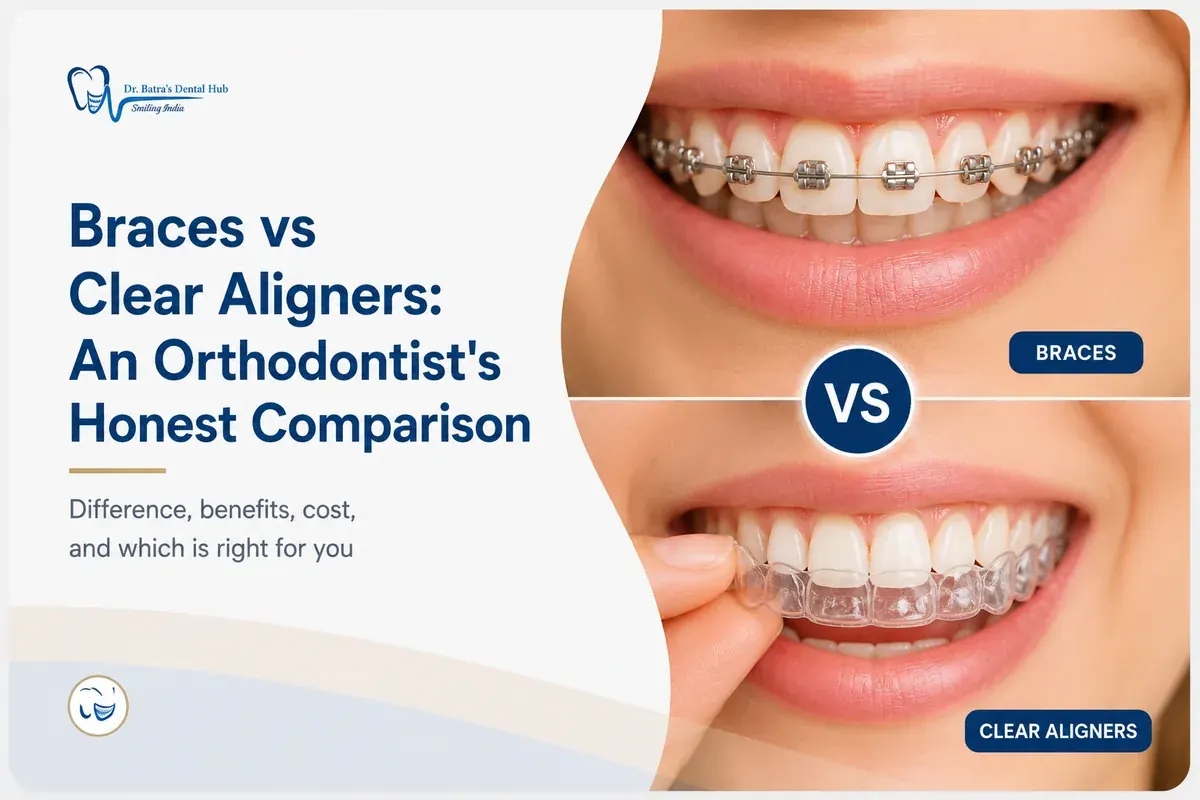
This is the question I am asked more than any other, and the honest answer is that it depends less on preference than most people expect. For some cases either option works well and it comes down to lifestyle. For others, one of them simply cannot do the job.
Here is how I actually think about it in the chair. If you have already decided which way you are leaning, you can read about dental braces and clear aligners directly.
How Each One Moves Teeth
Fixed braces bond a bracket to each tooth and connect them with an archwire. Because the bracket is physically attached, the wire can push, pull, rotate and torque a tooth in three dimensions with a high degree of control — including moving the root, not just tipping the crown.
Clear aligners are a series of custom-moulded transparent trays, each slightly different from the last. Each tray applies gentle pressure to move teeth a fraction of a millimetre. Small tooth-coloured attachments are usually bonded to certain teeth to give the tray something to grip, which is how aligners achieve rotations and more complex movements.
Both apply the same underlying biology — controlled force causes bone to remodel around the tooth. The difference is how much control the appliance has, and how much depends on the patient.
Where Each One Wins
| Fixed braces | Clear aligners | |
|---|---|---|
| Visibility | Visible (ceramic is subtler) | Nearly invisible |
| Removable | No | Yes — 20–22 hrs/day required |
| Complex movements | Excellent control | Good, with limits |
| Food restrictions | Yes — hard, sticky foods | None; trays come out to eat |
| Cleaning your teeth | Harder — brushing around brackets | Easy — remove and brush normally |
| Depends on patient discipline | Minimal | Almost entirely |
| Appointment frequency | Every 4–6 weeks | Every 6–10 weeks, often shorter visits |
| Emergencies | Loose brackets, poking wires | Rare — occasionally a lost tray |
The Cases Where Aligners Genuinely Struggle
Aligner marketing tends to imply they can treat anything. In practice there are movements where fixed appliances remain clearly better, and any orthodontist who tells you otherwise is overselling:
- Large vertical movements — significantly intruding or extruding a tooth. Trays have limited grip for pulling a tooth down or pushing it up.
- Severe rotations, particularly of round-rooted teeth like premolars and canines, where the tray has little purchase.
- Closing large extraction spaces with bodily movement of the roots, rather than simply tipping the crowns together.
- Significant skeletal discrepancies — where the jaws themselves, not just the teeth, are mismatched. These often need growth modification in children or surgical planning in adults.
- Patients who will not wear them. This is not a technical limitation, but it is by far the most common reason aligner treatment goes wrong.
Conversely, aligners are excellent for mild to moderate crowding, spacing, relapse after previous orthodontics, and adults who need discretion at work. For a large share of adult cases they are genuinely equivalent.
The Compliance Question Nobody Enjoys
Aligners must be worn 20 to 22 hours a day. That means they come out only to eat, drink anything other than water, brush and floss. Twenty hours sounds generous until you count a leisurely dinner, a few cups of chai, and a wedding.
At 20 hours a day, treatment tracks as planned. At 14 hours a day, teeth stop following the sequence, trays stop fitting, and we end up either restarting with new scans or switching to fixed appliances. The plan is not wrong — it just was not followed.
Braces do not ask this of you. They work whether you are motivated on a given week or not. For teenagers in particular, and for adults who know they are forgetful, that reliability is worth a great deal.
I would rather put a patient in braces and finish beautifully in eighteen months than put them in aligners they will not wear and spend three years chasing the plan.
— Dr. Japneet Kaur Batra, MDS
Treatment Time
For comparable cases, treatment times are broadly similar — typically 12 to 24 months, with simple cases finishing in 6 to 9 months. Anyone promising a dramatically shorter time with one appliance over the other is usually either describing a very simple case or planning to compromise the result.
One genuine difference: aligner appointments are usually shorter and less frequent, because you collect several trays at a time. If you travel often or have an inflexible schedule, that convenience matters.
Living With Each One
Braces
- Expect three to five days of soreness after fitting and after each adjustment.
- Avoid hard and sticky foods — nuts, hard chikki, ice, chewing gum. A loose bracket means an unscheduled visit.
- Cleaning takes longer. Interdental brushes and a water flosser are worth the investment.
- Ceramic brackets are far less visible than metal, at slightly higher cost and marginally more fragility.
Clear aligners
- Mild pressure for the first day or two of each new tray. Change trays at night so you sleep through the worst of it.
- You must brush before putting trays back in. Trapping sugar under a tray for hours is a reliable way to get cavities.
- No food restrictions at all, which patients consistently rate as the biggest quality-of-life advantage.
- A slight lisp for the first few days is common and resolves as your tongue adapts.
- Losing a tray sets you back. Keep the previous one as a backup.
Retention — the Part Everyone Forgets
Whichever appliance you choose, teeth have a lifelong tendency to drift back. Retainers are not optional and they are not temporary. Usually that means a thin bonded wire behind the front teeth, a removable retainer worn nightly, or both.
The most disappointing cases I see are relapses in people who had beautiful orthodontic results ten years ago and stopped wearing retainers after six months. Budget for retention from the start.
How to Actually Decide
Ask these questions in the order that matters:
- Is my case treatable with aligners at all? A clinical exam and 3D scan answers this definitively. If the answer is no, the decision is made.
- Will I realistically wear them 20+ hours a day? Be honest. There is no shame in knowing yourself.
- How much does visibility matter to me? For patient-facing professionals and adults, often a great deal. For a 13-year-old whose friends all have braces, often not at all.
- What is my budget? Aligners typically cost more than metal braces, with ceramic braces in between.
If aligners are viable and you will wear them, they are an excellent choice. If there is genuine doubt about either, fixed braces will give a more predictable result. You can read more about our clear aligner treatment and how we plan cases digitally.
Either way, insist on being treated by an MDS-qualified orthodontist rather than a general practice offering aligners as an add-on. The appliance matters far less than the diagnosis and treatment plan behind it.
Not sure which one suits your case?
The honest answer depends on what your teeth are actually doing. A consultation with a 3D scan will tell you which options genuinely work for you — and if both do, you get to choose.