
Your Child's First Dental Visit: When to Go and What Actually Happens
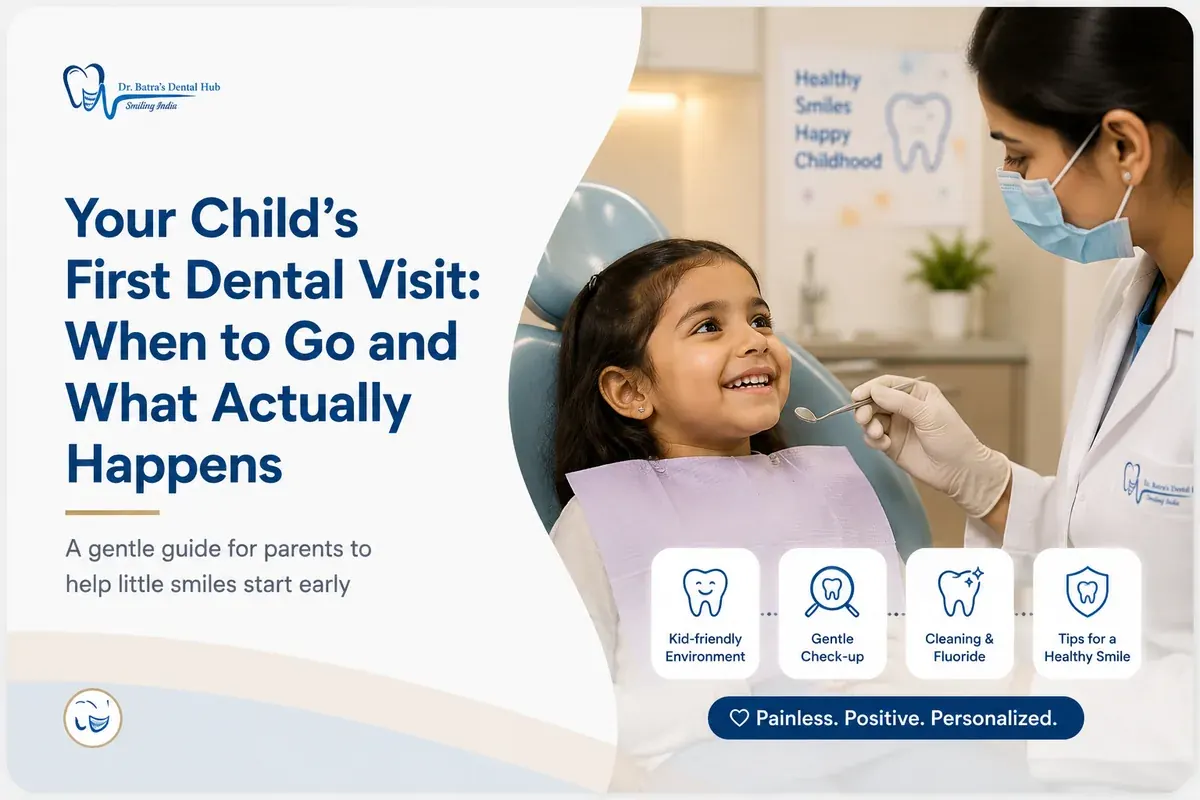
Most parents bring their child to a dentist for the first time somewhere between four and six years old, usually because something has started to hurt. By then, we are often managing a problem that could have been prevented entirely.
The recommended age will surprise many people. For what we actually provide for children, see paediatric dentistry.
The Right Age: By the First Birthday
The Indian Society of Pedodontics and Preventive Dentistry, the Indian Dental Association and the American Academy of Pediatric Dentistry all recommend the same thing: a first dental visit by the child's first birthday, or within six months of the first tooth appearing — whichever comes first.
That sounds absurdly early to most parents. A one-year-old has perhaps six or eight teeth. What is there to check?
Quite a lot, as it turns out — and more importantly, the visit is not really for the teeth.
Why So Early
- Early cavity detection. Early childhood caries can begin as soon as teeth appear. The earliest sign is a chalky white line along the gumline, which is easily missed and completely reversible at that stage.
- Feeding and habit guidance. Bottle-feeding to sleep, prolonged night feeds, and sweetened drinks in a sipper are the leading causes of early decay. Most parents have never been told this.
- Checking growth and development. Whether teeth are erupting in the right sequence, whether the bite is developing normally, whether there are any tongue-tie or airway concerns.
- Habit assessment. Thumb sucking and pacifier use are normal in infancy. Whether they are affecting jaw development is something worth watching early.
- Building familiarity — the real reason. A child who has visited a dental clinic five times without anything unpleasant happening has no reason to be afraid. A child whose first visit involves pain and an injection may carry that anxiety for decades.
That last point is the one I would emphasise most. Dental anxiety in adults very often traces back to a single bad early experience. Early, uneventful visits are the most effective prevention we have.
What Actually Happens at a First Visit
Far less than parents expect. For a toddler, the whole thing may take ten minutes.
- Talking first. We talk to you about feeding, brushing, and any concerns, while your child gets used to the room and realises nothing alarming is happening.
- A knee-to-knee examination for very young children. You sit facing the dentist, knees touching, and your child lies back across both laps looking up at you. They stay in physical contact with you the entire time. For older children, the dental chair — often with a ride up and down first, which is usually the highlight.
- A quick look. Counting teeth, checking for early white-spot lesions, looking at the gums and bite. Often with a mirror the child gets to hold first.
- Cleaning and fluoride, if appropriate. A gentle polish and a fluoride varnish painted on, which takes about a minute and tastes of fruit.
- Brushing demonstration for you. How to position a small child, how much toothpaste, how to actually reach the back teeth of a wriggling toddler.
- No X-rays unless there is a specific clinical reason. Routine radiographs are not part of a first visit for a young child.
There is no drilling, no injections and no treatment at a first visit unless there is an urgent problem. The goal is a child who leaves thinking the dentist is a pleasant place with a chair that goes up and down.
How to Prepare — and What Not to Say
Parents accidentally create most dental fear with well-meant reassurance.
Avoid saying
- “Don't worry, it won't hurt.” You have just introduced the concept of hurt. The child now knows hurt was on the table.
- “Be brave.” Bravery is for frightening things. This implies there is something to fear.
- “They won't give you an injection.” Same problem, and if one is ever needed later, you have lost their trust.
- “If you don't brush, the dentist will drill your teeth.” Please never use the dentist as a threat. We spend a lot of time undoing this one.
Better approaches
- Keep it matter-of-fact and brief. “We're going to see the tooth doctor who counts your teeth.”
- Book a morning appointment, when young children are at their best.
- Play dentist at home — let them count your teeth with a toothbrush and a torch.
- Read a picture book about visiting the dentist in the week beforehand.
- Stay relaxed yourself. Children read parental anxiety instantly, and if you are nervous about dentists, they will notice.
- Do not promise a reward for “being good” — it frames the visit as an ordeal to be endured.
Baby Teeth Matter More Than People Think
“They're only milk teeth, they'll fall out anyway” is the single most costly misconception in paediatric dentistry.
Baby teeth hold space for the permanent teeth developing above them. Losing a molar early lets neighbouring teeth drift into the gap, and the adult tooth then has nowhere to erupt — which is a common route into orthodontic treatment that could have been avoided. They also matter for chewing, for speech development, and for a child's confidence.
And decay in a baby tooth is a genuine infection. It causes pain, disturbed sleep, missed school, and can damage the permanent tooth forming beneath it. The last baby teeth are not lost until around age twelve — that is a long time to live with a painful tooth.
Preventing Problems Between Visits
- Start brushing at the first tooth. A soft infant brush, twice a day. A smear of fluoride toothpaste the size of a grain of rice under three; a pea-sized amount from three to six.
- Brush for them until about seven or eight. Children lack the manual dexterity for effective brushing long after they are keen to do it themselves. Let them go first, then you do a proper turn.
- No bottle in bed. Milk pooling around the teeth overnight, when saliva flow is lowest, is the classic cause of early childhood caries.
- Water between meals, not juice or sweetened milk. Frequency of sugar exposure matters more than total quantity.
- Ask about sealants when the first permanent molars arrive around age six. Pit and fissure sealants are quick, painless and highly effective at preventing decay in the grooves of back teeth.
- Keep to six-monthly check-ups. Children's teeth change quickly and small problems escalate faster than in adults.
The children who grow up without dental fear are almost always the ones whose first visit happened before anything hurt.
— Dr. Japneet Kaur Batra, MDS
If your child is already past their first birthday and has not seen a dentist, there is no point worrying about it — just book now. See our paediatric dentistry page for what we offer, or read about our sterilisation protocols if clinic hygiene is on your mind.
Ready to book your child's first visit?
First visits are short, gentle and mostly about getting comfortable. Message us and mention it is a first appointment — we will allow extra time and keep it relaxed.