
Invisalign Palatal Expander vs Traditional Expander: A Parent's Guide
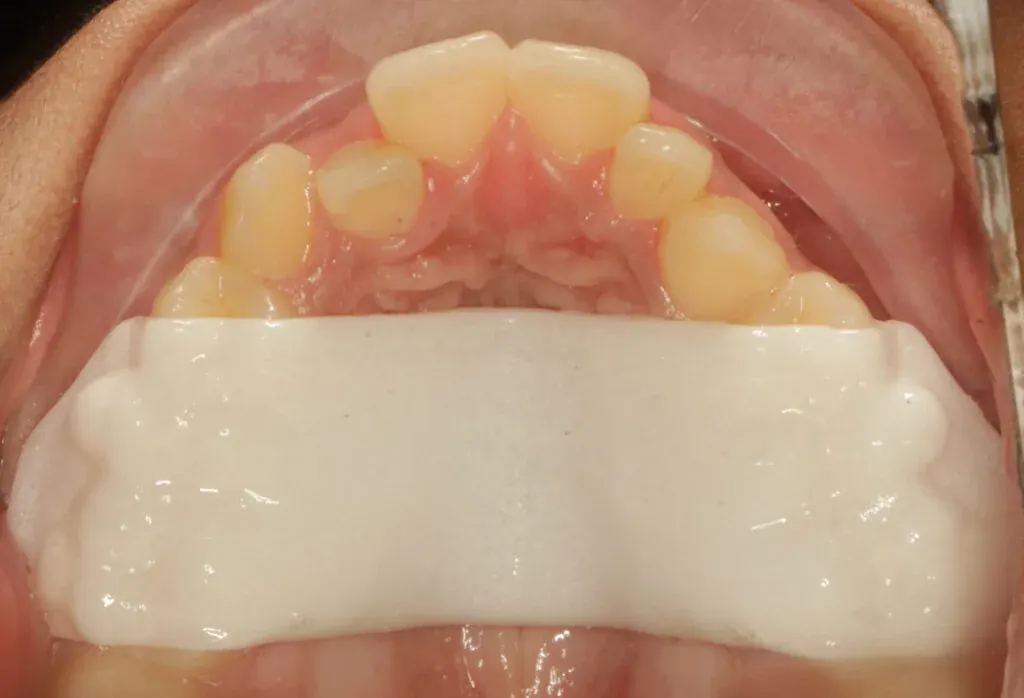
If an orthodontist has recommended a palatal expander for your child, you have probably had two reactions: relief that a problem was caught early, and unease at the idea of a metal appliance fixed to the roof of your child's mouth with a key that gets turned daily.
There is now a removable alternative. Here is an honest comparison of both, and — more importantly — an explanation of what expansion is actually doing, because that is the part that determines which option suits your child. For aligner treatment generally see clear aligners, and for children's care see paediatric dentistry.
Why Expansion Works Only in a Narrow Window
The roof of the mouth is formed by two halves of the maxilla joined at the midpalatal suture, running front to back along the midline. In children this suture is not fused — the two halves are joined by fibrous tissue and can still be separated.
A palatal expander applies gentle outward pressure across that suture. The halves separate slightly, new bone fills the gap, and the upper jaw becomes physically wider. This is skeletal change, not just tooth movement.
The suture progressively fuses through adolescence — typically beginning around 14 to 16 and completing in the early twenties, with wide individual variation. Once fused, the same appliance can only tip the teeth outward, not widen the jaw. Achieving genuine skeletal expansion then requires surgical assistance.
This is why orthodontists press on timing. It is not upselling. It is a biological window that closes.
Why a Child Might Need It
- Posterior crossbite — the upper back teeth bite inside the lower ones, because the upper jaw is too narrow. Often causes the lower jaw to shift sideways to find a comfortable bite, which over time can affect facial symmetry.
- Severe crowding — a narrow arch has insufficient room for permanent teeth. Widening can sometimes avoid extracting healthy teeth later.
- Impacted canines — creating space can help canines erupt normally rather than becoming impacted.
- Narrow airway and mouth breathing. The roof of the mouth is also the floor of the nose, so widening the palate increases nasal volume. There is genuine and growing interest in expansion for paediatric sleep-disordered breathing, though it should be said the evidence is still developing and expansion is not a standalone treatment for sleep apnoea.
The Traditional Fixed Expander (RPE)
A rapid palatal expander is cemented to the upper molars with a jackscrew across the palate. Parents turn a small key once or twice daily, each turn producing a fraction of a millimetre of expansion. Active expansion usually takes two to four weeks, then the appliance stays in place for several months while new bone consolidates.
Advantages
- Compliance is not a factor. It is cemented in. This is the decisive advantage with young children.
- Strong, predictable skeletal force. Effective even in more resistant cases.
- Well established. Decades of clinical evidence and predictable outcomes.
- Not lost. It cannot be left at school or thrown out with a lunch tray.
Drawbacks
- Initial pressure and a feeling of fullness; a few days of adjustment.
- A temporary lisp while the tongue adapts — usually resolving within a week or two.
- Food trapping under the appliance. Cleaning takes real effort and a water flosser helps.
- A visible gap often opens between the upper front teeth. This alarms parents and is actually the clearest sign it is working — the gap closes naturally over the following months.
- The parent has to perform the daily turns, which some find stressful.
The Invisalign Palatal Expander
A newer, removable 3D-printed appliance. Instead of one device turned progressively, the child receives a series of trays, each slightly wider than the last, changed on a schedule. It is direct-printed from a digital scan and is worn like a retainer over the palate.
Advantages
- Removable for eating and brushing, so hygiene is far easier and food trapping is largely eliminated.
- More comfortable. Smooth printed surfaces, no metal bands, no key turning.
- No daily turning by the parent — trays are simply changed on schedule.
- Discreet, which matters to older children.
- Digitally planned, so expansion is mapped out from the start.
Drawbacks
- Entirely dependent on wear. It needs to be in the mouth around 22 hours a day. A child who does not wear it does not get expansion.
- It can be lost. Replacement trays cost time and money.
- Narrower indications. It is not suitable for every case, particularly more severe skeletal discrepancies or older children with partially fused sutures.
- Less long-term data. This is the honest caveat — it is a newer appliance and does not yet have the decades of published follow-up that fixed RPEs do.
- Typically higher cost.
Side by Side
| Fixed RPE | Invisalign Palatal Expander | |
|---|---|---|
| Removable | No | Yes |
| Depends on child's cooperation | No | Almost entirely |
| Daily parental involvement | Yes — key turning | Minimal |
| Ease of cleaning | Difficult | Easy |
| Comfort | Moderate initially | Generally better |
| Suitable for severe cases | Yes | Limited |
| Evidence base | Extensive, decades | Growing, newer |
| Can be lost | No | Yes |
Which One for Which Child
In practice the decision usually comes down to two questions: how severe is the discrepancy, and how reliable is the child?
A fixed RPE is usually the better choice for younger children (roughly 7 to 10), for significant crossbites or marked skeletal narrowness, for children who lose things or resist wearing appliances, and where predictable results matter more than comfort.
The Invisalign expander suits mild to moderate cases in a demonstrably cooperative child, older children who are self-conscious, children with hygiene difficulties or a high caries risk, and families who prefer to avoid a fixed appliance.
I have had eight-year-olds who wear a removable appliance impeccably and fourteen-year-olds who cannot manage it. It is genuinely about the individual child, not the age on the chart.
— Dr. Japneet Kaur Batra, MDS
What to Expect Either Way
- Some pressure at the start. Children usually describe it as odd rather than painful, and adapt within days.
- A temporary lisp. Reading aloud for a few minutes each day helps the tongue adapt faster.
- Soft food for the first day or two of each new stage.
- A midline gap that then closes. Expect it, and do not be alarmed.
- A retention period. Expansion is held for several months while bone consolidates. Skipping this causes relapse.
- Braces or aligners later, usually. Expansion creates the skeletal foundation; aligning the teeth is generally a separate second phase.
When to Have Your Child Assessed
Around age seven is the widely recommended point for a first orthodontic assessment. Enough permanent teeth have arrived to reveal how the bite is developing, and the suture is still wide open.
An assessment does not mean treatment starts. Frequently the outcome is simply monitoring for a year or two. But it means the window is not missed — and expansion is one of the clearest examples in orthodontics where timing changes what is possible.
Read more about paediatric dentistry and orthodontic treatment, or see our guide to braces versus clear aligners for the second phase.
Not sure if your child needs expansion?
Timing matters more than the appliance. A short assessment will tell you whether expansion is needed and — importantly — whether now is the right window.