
Bleeding Gums: What Your Gums Are Trying to Tell You
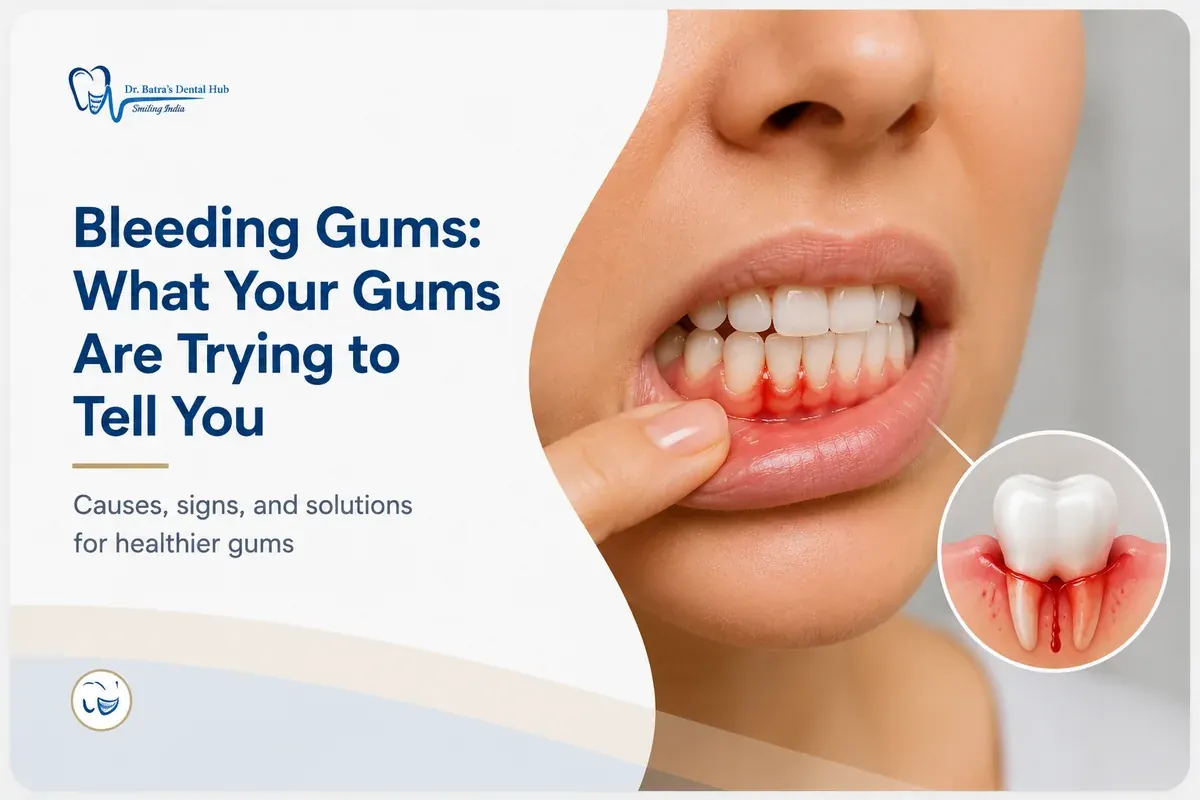
Most people see a little pink in the sink and think nothing of it. They brush a bit more gently next time and move on. It is probably the single most commonly ignored symptom in dentistry.
Here is the thing worth knowing: healthy gums do not bleed. They do not bleed when you brush, they do not bleed when you floss, and they do not bleed when you eat an apple. Skin on your arm does not bleed when you wash it, and gum tissue is no different. Bleeding means inflammation, and inflammation always has a cause. If you already know your gums bleed and want the clinical side rather than the explanation, see gum disease treatment.
Why Gums Bleed
In the overwhelming majority of cases, bleeding gums are caused by bacterial plaque sitting along the gumline. Plaque is a soft, sticky biofilm that forms continuously. If it is not removed within about 24 to 48 hours it begins to mineralise into calculus — tartar — which is hard, porous, and impossible to remove with a toothbrush.
Your immune system recognises the bacteria and mounts an inflammatory response. Blood vessels in the gum dilate and become fragile. That is why the tissue bleeds at the slightest touch.
The counterintuitive part
When gums bleed, the instinct is to brush that area more gently or avoid it. This is exactly backwards. Avoiding the area leaves more plaque, which drives more inflammation, which causes more bleeding. Patients who gently but thoroughly clean a bleeding area usually find the bleeding stops within one to two weeks.
Gingivitis vs Periodontitis — the Distinction That Matters
These two terms get used loosely, but the difference between them is the single most important thing in this article.
| Gingivitis | Periodontitis | |
|---|---|---|
| What is affected | Gum tissue only | Gum, ligament and the bone holding the tooth |
| Signs | Red, puffy gums that bleed | Bleeding, receding gums, bad breath, gaps opening, loose teeth |
| Pain | Usually none | Usually none until advanced |
| Bone loss | None | Permanent |
| Reversible? | Yes — completely | No — can be stabilised but not reversed |
| Typical treatment | One professional cleaning plus better home care | Deep cleaning below the gumline, sometimes surgery, ongoing maintenance |
Gingivitis is the stage where you get a free pass. Remove the plaque and calculus and the tissue returns to full health with no lasting damage. Once it progresses to periodontitis, the bone that anchors your teeth begins to dissolve — and bone does not grow back on its own.
The reason people miss the transition is that neither stage is painful. Gum disease is the leading cause of tooth loss in adults precisely because it does not hurt until it is too late.
Causes Beyond Poor Brushing
Plaque is the main driver, but several other factors make gums bleed or make existing inflammation worse.
- Smoking and tobacco. Nicotine constricts blood vessels, which can mask bleeding and hide the problem while the disease progresses underneath. Smokers often present with advanced disease and surprisingly little bleeding.
- Diabetes. The relationship runs both ways — poorly controlled blood sugar worsens gum disease, and active gum inflammation makes blood sugar harder to control.
- Pregnancy and hormonal change. Pregnancy, puberty and the menstrual cycle all raise the gum tissue's inflammatory response to the same amount of plaque. Pregnancy gingivitis is common and needs attention, not dismissal.
- Vitamin C and vitamin K deficiency. Less common than the internet suggests, but genuine in people with very restricted diets.
- Blood thinners and some medications. Anticoagulants, and drugs that cause gum overgrowth such as certain anti-epileptics, calcium channel blockers and immunosuppressants.
- Badly fitting fillings or crowns. An overhanging edge creates a plaque trap that no amount of brushing will clean.
- Crowded or crooked teeth. Overlapping teeth create spaces a brush cannot physically reach. This is one of the health arguments for orthodontic treatment beyond appearance.
When to Stop Waiting and See a Dentist
- Bleeding that continues for more than two weeks despite good brushing and flossing
- Gums that are receding, or teeth that look longer than they used to
- Persistent bad breath or a bad taste that brushing does not fix
- Any tooth that feels loose, or a bite that feels like it has changed
- Pus at the gumline, or a gum abscess
- Spontaneous bleeding — bleeding without touching the gums at all
That last one, and any tooth mobility, should be treated as urgent rather than routine.
What Treatment Actually Involves
Treatment is far less dramatic than most people fear.
- Assessment. We measure the depth of the space between gum and tooth at several points around each tooth. Healthy is 1–3mm. Deeper pockets indicate attachment loss. X-rays show the bone level.
- Professional cleaning (scaling). Ultrasonic instruments remove calculus above and just below the gumline. For gingivitis this is usually all that is needed. See professional teeth cleaning.
- Root planing, if pockets are deeper. Cleaning of the root surfaces below the gumline, done under local anaesthetic, usually across a couple of appointments.
- Laser-assisted therapy where indicated. Dental lasers can decontaminate pockets and help tissue reattach, with less bleeding and faster healing than conventional instrumentation alone.
- Maintenance. Once stabilised, three- to six-monthly reviews. Gum disease is a chronic condition — it is managed, not cured.
Home Care That Genuinely Works
- Angle the brush at 45 degrees to the gumline, not straight at the tooth. The bristles need to reach just under the gum edge, which is where plaque accumulates.
- Two minutes, twice a day. Most people brush for about 45 seconds and are convinced it was two minutes. Time it once and you will be surprised.
- Clean between the teeth daily. A toothbrush cannot reach roughly 40% of the tooth surface. Interdental brushes are generally more effective than floss where the gaps allow them.
- Soft bristles, light pressure. Hard brushing does not clean better — it damages gum tissue and wears away root surface. If your bristles splay within a month, you are pressing too hard.
- Do not rely on mouthwash. It reduces bacterial load but cannot remove a biofilm. It supplements brushing; it does not replace it.
If I could get one message across, it is that painless does not mean harmless. The gum disease that costs people their teeth in their fifties was completely reversible in their twenties.
— Dr. G. S. Batra, MDS
Why Gum Health Is Worth Taking Seriously
Beyond keeping your teeth, chronic gum inflammation has been consistently associated with cardiovascular disease, poorly controlled diabetes, rheumatoid arthritis and adverse pregnancy outcomes. The research is still working out how much of that link is causal and how much reflects shared risk factors, so it would be overstating things to say gum disease causes heart disease. But it is a genuine ongoing inflammatory burden on the body, and it is one of the more straightforward ones to remove.
A routine check-up includes a gum assessment. If your gums have been bleeding and you have been quietly ignoring it, that appointment is the whole intervention.
Gums bleeding for more than two weeks?
Early gum disease is completely reversible, and the treatment is usually a single cleaning appointment. Left alone it is not reversible. Book a gum assessment and find out exactly where you stand.