
Why Tooth Pain Gets Worse at Night — and What to Do About It
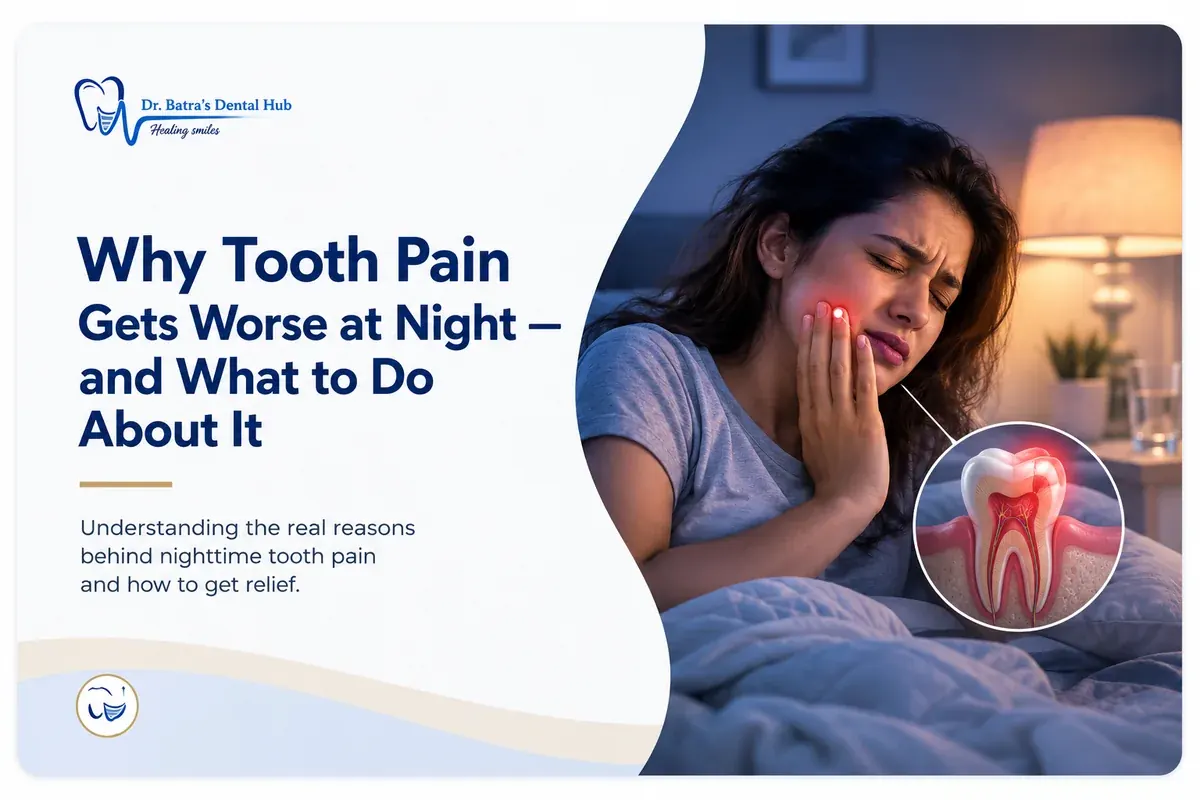
If you have ever lain awake at 2am with a throbbing tooth, wondering why it barely bothered you all day, you are not imagining it. Tooth pain genuinely does intensify at night, and there are real physiological reasons for it.
This guide explains why night-time dental pain is worse, how to read what your pain is telling you, what actually helps until morning, and — importantly — which symptoms mean you should not wait. Where the cause turns out to be an inflamed or dying nerve, root canal treatment is usually what resolves it; if it cannot wait, see emergency dental care.
Why Tooth Pain Intensifies at Night
Three things happen when you lie down, and they compound each other.
1. Blood flow to your head increases
When you are upright, gravity helps drain blood away from your head. Lying flat increases blood pressure in the vessels of your face and jaw. If a tooth is inflamed or infected, the pulp inside it is already swollen inside a rigid chamber of dentine that cannot expand. Extra blood flow raises the pressure on the nerve, and pressure on a nerve is pain.
2. You have nothing to distract you
During the day your attention is spread across work, conversation, traffic and screens. Pain signals compete with all of that. At night there is nothing else — the room is quiet and dark, and your full attention lands on the one thing that hurts. This is a genuine effect on perceived pain intensity, not weakness.
3. Night-time grinding and clenching
Many people clench or grind during sleep without knowing it. If a tooth is cracked, has a deep filling, or is already inflamed, hours of unconscious clamping force will inflame it further. You then wake with pain that seems to have appeared from nowhere.
What the Type of Pain Is Telling You
The character of the pain is genuinely diagnostic. Being able to describe it accurately will help your dentist enormously.
| What you feel | What it often means | Urgency |
|---|---|---|
| Sharp, brief pain with cold or sweet, gone in seconds | Sensitivity, an early cavity, exposed root surface or a worn filling | Routine appointment |
| Lingering ache for minutes after something hot or cold | The pulp is inflamed and may not recover on its own | See a dentist within days |
| Deep, spontaneous throbbing that wakes you | Irreversible pulpitis — the nerve is dying | Prompt appointment; likely root canal |
| Pain on biting or releasing a bite | Cracked tooth, or infection at the root tip | Prompt appointment |
| Constant pain with facial swelling | Abscess — infection has spread beyond the tooth | Same-day, urgent |
| Pain with fever, difficulty swallowing or opening your mouth | Spreading infection | Emergency — go now |
What Actually Helps Tonight
None of this treats the cause, but it will make the next few hours more bearable.
- Sleep propped up. Two or three pillows, or sleep in a recliner. Keeping your head above your heart directly reduces the vascular pressure that makes the throb worse.
- Cold compress on the outside of the cheek. Fifteen minutes on, fifteen off. This reduces both swelling and nerve conduction.
- Take pain relief properly, not sparingly. Take the correct dose at the correct interval rather than waiting until the pain becomes unbearable. If you have any medical conditions or take other medication, check with a pharmacist or doctor first.
- Rinse with warm salt water. Half a teaspoon in a glass of warm water. It will not cure anything but it soothes inflamed gum tissue and clears debris.
- Avoid the trigger. Chew on the other side. Skip very hot, very cold, sweet or acidic food and drink until you have been seen.
What Not to Do
- Do not hold an aspirin against the gum. This is a persistent myth. Aspirin is acidic and will cause a chemical burn on the soft tissue. Painkillers work through the bloodstream — swallow them.
- Do not apply heat. If there is any infection, heat encourages it to spread.
- Do not start antibiotics you have lying around. Leftover antibiotics are usually the wrong drug at the wrong dose, they will not drain an abscess, and they contribute to resistance.
- Do not assume it is fixed when the pain stops. Pain disappearing suddenly can mean the nerve has died. The infection is still there and will resurface, usually worse.
Red Flags That Mean Don't Wait Until Morning
Most toothache can safely wait for a next-day appointment. These cannot:
- Swelling that is spreading across your face, or closing your eye
- Swelling under the jaw or in the floor of the mouth
- Difficulty swallowing, breathing, or opening your mouth more than a couple of centimetres
- Fever alongside dental pain
- A tooth knocked out or pushed out of position by trauma
- Uncontrolled bleeding after an extraction
Dental infections sit close to the airway and to the spaces of the neck. They are usually straightforward when treated early and genuinely dangerous when ignored. If you are reading this list and recognising yourself, seek care now rather than in the morning.
What Treatment Will Actually Involve
Patients often delay care because they imagine the treatment will be worse than the pain. Almost always it is the opposite — treatment is what stops the pain.
- Deep cavity, healthy nerve: the decay is removed and the tooth restored with a filling. One visit.
- Inflamed or dying nerve: root canal treatment removes the infected pulp and seals the canal. Modern rotary endodontics means most cases are completed in a single sitting under local anaesthetic.
- Abscess: the infection is drained and the source treated. Relief is usually immediate and dramatic.
- Unrestorable tooth: a gentle extraction, with replacement options such as dental implants discussed afterwards.
Almost every patient who comes in with severe night pain says the same thing afterwards — that they wish they had come in a week earlier. Pain is information. It is worth acting on early.
— Dr. G. S. Batra, MDS
How to Stop It Happening Again
Night pain is nearly always the end point of a problem that has been developing quietly for months. Cavities do not become painful until they are deep; gum disease is painless until it is advanced. That is precisely why routine check-ups matter — they catch problems while they are still small, cheap and painless to fix.
If you know you clench or grind, a custom night guard is a simple intervention that protects your teeth from years of cumulative damage. And if a particular tooth has been quietly sensitive for a while, have it looked at before it escalates into a 2am problem.
In pain right now?
Don't wait until morning to get advice. Message us on WhatsApp and we will tell you honestly whether you need to be seen today or whether it can wait for a routine appointment.