
Root Canal Treatment: Why It Has a Bad Reputation It No Longer Deserves
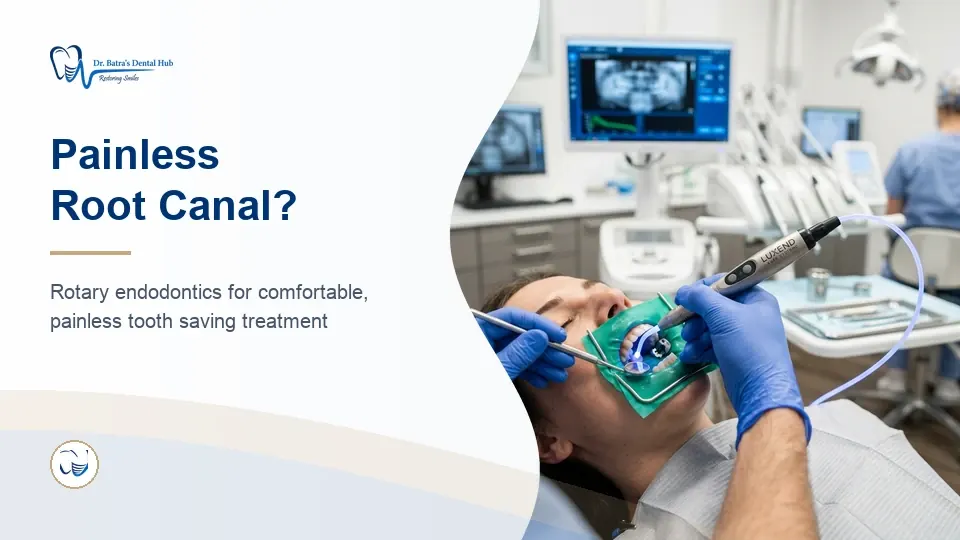
Few procedures carry as much dread as the root canal. The phrase is used as a byword for suffering — people say things are 'worse than a root canal' as a figure of speech.
That reputation was earned decades ago, before modern anaesthesia, rotary instrumentation and digital imaging. Today the honest position is this: the root canal is not the painful part. The infection that made it necessary is. The treatment is what stops the pain. For the treatment page itself, see root canal treatment.
What a Root Canal Actually Treats
Inside every tooth is a chamber containing the pulp — nerve tissue, blood vessels and connective tissue — running down through canals inside each root. When decay, a crack or repeated dental work lets bacteria reach the pulp, it becomes inflamed and eventually infected.
The problem is that the pulp is enclosed in rigid dentine that cannot expand. Inflammation causes swelling; swelling in a rigid space causes pressure; pressure on a nerve causes the deep, relentless ache that makes people ring the clinic at midnight.
Once the pulp is irreversibly inflamed it will not recover. There are exactly two options: remove the pulp and keep the tooth, or remove the tooth.
Why It Genuinely Does Not Hurt Now
Anaesthesia has improved considerably
Topical gel numbs the surface before the needle. Modern local anaesthetics work faster and more reliably. Where a tooth is 'hot' — acutely inflamed and harder to numb — supplementary techniques such as intraligamentary or intraosseous injections deal with the cases that historically caused problems.
You should not feel pain during a root canal. Pressure and vibration, yes. Pain, no. If you do, the correct response is to raise your hand and have more anaesthetic given — not to endure it.
Rotary instrumentation replaced hand files
Cleaning root canals used to mean manually working through a series of hand files, which was slow and imprecise. Nickel-titanium rotary instruments are flexible enough to follow curved canals and shape them in a fraction of the time. Shorter appointments, more thorough cleaning.
Apex locators removed the guesswork
Cleaning must extend to the exact end of the root — no further. Too short leaves infected tissue; too far pushes debris into the bone and causes post-operative pain. Electronic apex locators measure the canal length precisely, rather than estimating from X-rays alone.
Magnification
Loupes and microscopes reveal canal anatomy invisible to the naked eye. Missed canals are a leading cause of root canal failure — a molar that appears to have three canals frequently has four.
Single-Sitting vs Multiple Visits
Most straightforward cases can be completed in one appointment of about 45 to 90 minutes. Single-sitting treatment is well supported by evidence for suitable cases and has a clear advantage: no temporary dressing to leak or fail between visits.
Multiple visits remain appropriate when there is an active abscess needing drainage, severe infection where medicated dressing helps, unusually complex anatomy, or when a patient cannot comfortably stay open that long. Neither approach is universally better — it depends on the tooth.
What Actually Happens
- Diagnosis. X-ray, and tests of how the tooth responds to cold and to tapping, to confirm the pulp is irreversibly affected.
- Anaesthesia. Topical gel, then local anaesthetic. We wait and test before starting.
- Rubber dam. A thin sheet isolating the tooth. It keeps saliva and bacteria out of the canal, stops anything falling to the back of your throat, and is a genuine marker of quality — treatment without a dam has measurably worse outcomes.
- Access. A small opening through the biting surface into the pulp chamber.
- Cleaning and shaping. Rotary files remove infected tissue; irrigants disinfect the canal system. This is the bulk of the appointment.
- Filling. Canals are dried and sealed with gutta-percha and sealer, so bacteria cannot recolonise.
- Restoration. The access cavity is sealed. Back teeth almost always need a crown afterwards.
Why the Crown Afterwards Is Not Optional
This is where treatment most often goes wrong, and it is usually a decision the patient makes.
A root-treated back tooth has lost internal structure and no longer has the pulp's hydration. It becomes more brittle, and molars absorb heavy chewing forces. Without a crown the tooth can fracture — sometimes below the gumline, at which point it cannot be saved and the entire root canal was wasted.
Skipping the crown to save money is, in our experience, the most common reason a successful root canal ends in extraction two years later.
Is Saving the Tooth Worth It?
Almost always, yes. No replacement performs as well as a natural tooth root. Keeping it preserves the bone, maintains the bite, and avoids the neighbouring teeth drifting.
Modern root canal treatment has high success rates when performed properly and restored promptly. Compared with extraction followed by an implant or bridge, it is usually faster, less invasive and less expensive.
Extraction is the better choice when the tooth is fractured vertically, when too little tooth structure remains to hold a restoration, or when severe bone loss has already compromised support.
Patients tell me afterwards that the worst part was the week they spent worrying about it. The appointment itself is usually uneventful.
— Dr. G. S. Batra, MDS
Afterwards
- Mild tenderness to biting for a few days is normal — the ligament around the root is bruised.
- Take pain relief as advised for the first day or two rather than waiting for discomfort.
- Avoid chewing on that side until the permanent crown is fitted.
- Severe pain, swelling, or a temporary filling that comes out warrants a call, not a wait.
If you are facing treatment, read more about root canal treatment at our clinic — or if you are currently in pain, see what to do about severe tooth pain tonight.
Have a tooth that needs treating?
If you have been told you need a root canal and are anxious about it, come and talk it through first. We can show you the X-ray and explain exactly what is involved before you decide.