
Dental Sterilisation: What Actually Keeps You Safe (and How to Check)
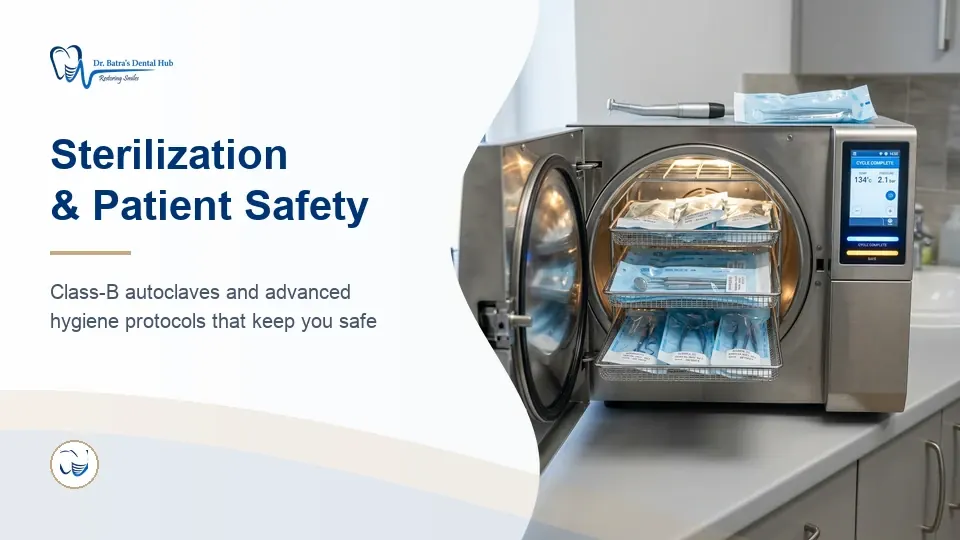
Sterilisation is the part of dentistry patients think about least and should probably think about most. You can see whether a clinic looks clean. You cannot see whether the instrument about to enter your mouth was properly processed.
This article explains how it actually works, and gives you specific things to look for so you can judge any clinic — including ours. You can also see our clinic sterilisation protocols set out in full.
Why It Matters in Dentistry Specifically
Dental procedures involve blood, saliva and aerosols, often with instruments that have hinges, hollow channels and fine serrations — exactly the geometry that is hardest to clean. Bloodborne viruses including hepatitis B, hepatitis C and HIV are the recognised concerns, and hepatitis B in particular is remarkably hardy, surviving on surfaces for up to a week.
This is entirely manageable with correct protocol. It is not manageable with shortcuts.
Disinfection Is Not Sterilisation
These words get used interchangeably and they are not the same thing.
- Cleaning removes visible debris. Necessary first step, kills nothing.
- Disinfection kills most micro-organisms but not bacterial spores. Appropriate for surfaces such as worktops and chairs.
- Sterilisation destroys all microbial life including spores. This is the only acceptable standard for anything entering your mouth.
A clinic that wipes instruments with disinfectant and reuses them has not sterilised them. Anything that penetrates tissue or contacts mucous membranes must be sterilised, not merely disinfected.
The Class B Autoclave — the Detail That Matters Most
Autoclaves use pressurised steam at 121–134°C. But there are classes, and the difference is genuinely important.
| Class | How it works | Can it sterilise hollow instruments and pouches? |
|---|---|---|
| Class N | Gravity displacement — steam pushes air downward | No. Solid unwrapped instruments only |
| Class S | Manufacturer-specified partial vacuum | Partially — depends on the model |
| Class B | Fractionated pre-vacuum — repeatedly evacuates all air | Yes — hollow, wrapped and porous loads |
Here is why this is the crux of it. Steam sterilises only where steam actually touches. Air is an insulator; a trapped air pocket inside a handpiece channel or a sealed pouch means that spot never reaches sterilising temperature, no matter how long the cycle runs.
A Class N autoclave relies on steam displacing air by gravity, which does not work for hollow lumens or wrapped instruments. A Class B autoclave pulls repeated deep vacuums before admitting steam, removing essentially all air first. For dental handpieces — which are hollow and are used inside your mouth at high speed — this is the only appropriate standard.
The Protocol We Follow
- Immediate immersion. Instruments go straight into an enzymatic disinfectant solution so debris cannot dry on. Dried blood and protein shield organisms from steam.
- Ultrasonic cleaning. High-frequency sound waves create microscopic cavitation bubbles that clean hinges, serrations and joints far more effectively — and far more safely for staff — than hand scrubbing.
- Rinse and full drying. Residual moisture causes corrosion and interferes with steam penetration.
- Pouching with indicators. Instruments are sealed in medical-grade pouches carrying a chemical indicator that changes colour only after correct exposure. The pouch is what keeps them sterile after the cycle.
- Class B vacuum autoclave cycle. Fractionated pre-vacuum, then pressurised steam at 134°C.
- Cycle verification. Every load is checked against its chemical indicator. Any cycle that does not meet criteria is reprocessed from step one.
- Operatory turnover. Between patients, all contact surfaces are wiped with high-level disinfectant and single-use barriers on high-touch points are replaced.
- Waste segregation. Colour-coded bio-waste bins and immediate electrical needle destruction, in line with Bio-Medical Waste Management Rules.
How to Check Any Clinic — Six Specific Questions
You do not need technical knowledge. Ask these:
- “Can I see your sterilisation area?” The answer matters more than the room. Confident clinics say yes immediately.
- “What class is your autoclave?” You want to hear Class B. If nobody knows, that is an answer.
- “Are instruments pouched?” Then watch whether your pouch is opened at the chair, in front of you. Instruments laid out on a tray before you arrive cannot be verified.
- “Do you run biological indicator tests?” Spore tests confirm the autoclave is actually killing organisms, not just reaching temperature. This is the gold standard and not every clinic does it.
- “Are handpieces sterilised between patients?” The drill itself must be autoclaved, not just wiped. This is a common shortcut because handpieces are expensive and clinics need several.
- “How is sharps waste handled?” Needle destroyer and colour-coded bins.
Every cycle is checked against its indicator, and any load that does not meet criteria goes back to step one. It is unglamorous and it is the most important thing we do.
— Dr. G. S. Batra, MDS
What You Should Be Able to Observe
- Fresh gloves put on in front of you, and changed between patients
- A mask and eye protection on the clinician
- Your instrument pouch opened at the chair
- Disposable barriers on the chair, light handle and controls
- Single-use items — needles, suction tips, gloves, bibs — visibly disposed of, never reused
- A dedicated sterilisation area, not instruments processed in the treatment room sink
None of this requires you to be an expert. It requires you to look.
You can read more about our safety protocols, or simply ask to see the room at your next visit. We would rather show you.
Want to see the sterilisation room?
You are welcome to ask for a look before any treatment. We would rather you saw it than took our word for it.