What Actually Affects the Cost of a Dental Implant
Ask three clinics for an implant quote and you may get three very different numbers. That variation is not arbitrary, but it is rarely explained — which leaves patients choosing on price alone without knowing what differs.
This article explains what actually drives the cost, so you can compare quotes properly. We are deliberately not publishing a price list here, because a number without a diagnosis is meaningless — the same missing tooth can need very different treatment depending on what the bone looks like. This article covers the factors that move the price. For local figures specifically, see our South Bopal implant cost guide; for the procedure itself, dental implants.
An Implant Is Three Separate Things
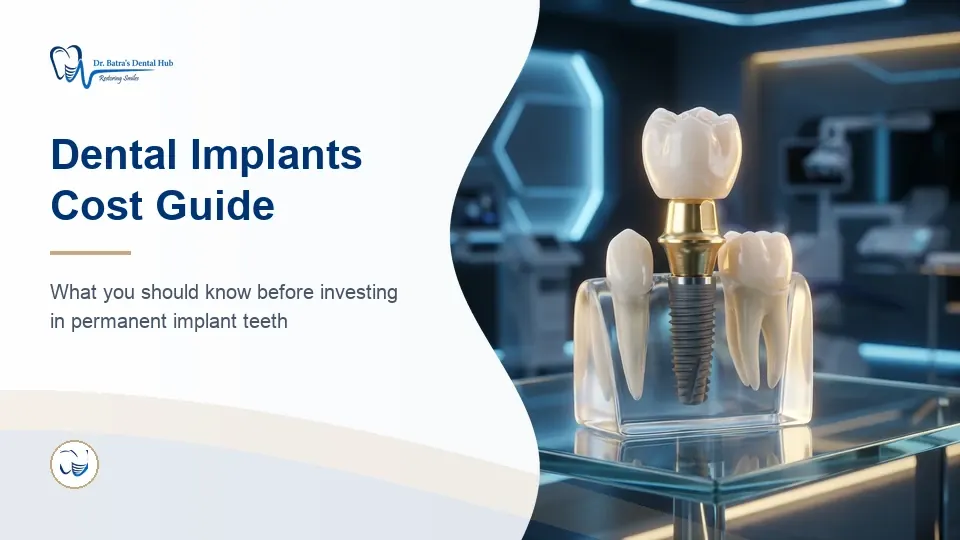
This causes more confusion than anything else. A dental implant is not one item. It is:
- The fixture — the titanium screw placed in the bone.
- The abutment — the connector between fixture and crown.
- The crown — the visible tooth.
Some quotes include all three. Some quote only the fixture, with the abutment and crown billed later. This alone can make one quote look dramatically cheaper than another for identical treatment. Always ask whether the quote is for the complete restored tooth.
1. The Implant System
Implant brands are not interchangeable. The meaningful differences are in surface technology, the precision of the fixture-abutment connection, and — most practically — how much long-term clinical data exists behind them.
Premium European systems such as Straumann and Nobel Biocare have decades of published follow-up and cost more. Established Korean systems such as Osstem and Dentium are considerably less expensive with good published outcomes. At the bottom of the market there are systems with almost no independent long-term data.
One point that rarely gets mentioned and matters a great deal: if an implant needs repair in fifteen years, you need the matching components. Widely used systems will still be supported and stocked. An obscure system may not exist by then, and a fixture that cannot be restored has to be surgically removed.
2. Whether You Need Bone Grafting
This is the single biggest variable, and it is why quoting without a scan is unreliable.
Bone begins resorbing as soon as a tooth is lost — around 25% of the width in the first year. If a tooth has been missing for years, there may not be enough bone left to hold an implant, and grafting or a sinus lift is needed first. That adds materials, surgical time and often several months of healing.
Two patients with the same missing tooth can therefore need quite different treatment. This is also a strong argument for not delaying: an implant placed sooner after extraction is usually simpler and less expensive than one placed five years later.
3. The Crown Material
Zirconia and lithium disilicate crowns are more translucent, more natural-looking and more expensive than porcelain-fused-to-metal. For a back molar where appearance matters less, PFM may be perfectly sensible. For a front tooth, the aesthetic difference is significant.
4. Planning and Diagnostics
A CBCT scan shows bone height, width and density in three dimensions and locates nerves and sinuses. Guided surgery, where a 3D-printed surgical guide transfers the digital plan precisely to the mouth, adds cost and adds accuracy.
This is not an upsell. Implant position determines whether the final crown can be cleaned, whether it looks right, and how forces are distributed. A well-placed implant with a moderate fixture will outlast a premium fixture placed badly.
5. Who Is Doing It
An MDS prosthodontist or oral surgeon has three years of postgraduate training in this specific work. A general dentist may have completed a short certification course. Both may be entirely competent for a straightforward case; the difference shows in complex ones — thin bone, aesthetic zones, full-arch cases.
6. The Number and Type of Implants
Full-arch solutions are not one implant per tooth. All-on-4 and All-on-6 restore a complete arch on four or six implants, which is far less expensive than twelve individual implants but requires more surgical planning.
Why the Cheapest Quote Is Often the Most Expensive
The failure modes are worth understanding, because when an implant fails it rarely fails cheaply:
- Failed osseointegration. The fixture never bonds. It is removed, the site heals for months, and you start again.
- Peri-implantitis. Gum and bone infection around the implant. Poor positioning makes an implant impossible to clean properly, which makes this far more likely.
- Unrestorable positioning. Placed at the wrong angle, the crown cannot be made to look or function correctly.
- Discontinued components. A cheap system with no long-term support cannot be repaired later.
Redoing a failed implant typically costs more than doing it properly the first time, because you are now also treating a damaged site.
I am not arguing for the most expensive option. I am arguing for knowing what you are buying — which brand, who is placing it, and whether the quote covers the finished tooth.
— Dr. G. S. Batra, MDS
How to Compare Two Quotes Properly
Ask both clinics the same six questions:
- Does this price include the fixture, abutment and crown?
- Which implant system, and which manufacturer?
- Is a CBCT scan included, and is bone grafting likely to be needed?
- What material is the crown?
- Who places the implant, and what is their qualification?
- What warranty or follow-up applies if it fails, and what would a replacement cost?
With those answers you are comparing like with like. Without them you are comparing two unrelated numbers.
On Value Over Time
A bridge typically needs replacing every 10 to 15 years, and each replacement removes more structure from the supporting teeth. A denture needs relining and remaking. A well-placed implant frequently lasts decades. Over a thirty-year horizon the arithmetic often favours the implant even though the initial outlay is higher.
That said, implants are not right for everyone — see when implants are and are not the right choice. If you would like an assessment, read more about our implant treatment or book a consultation.
Want an itemised quote?
After a scan we provide a written plan listing every component and stage, so you can see exactly what is and is not included before deciding anything.